
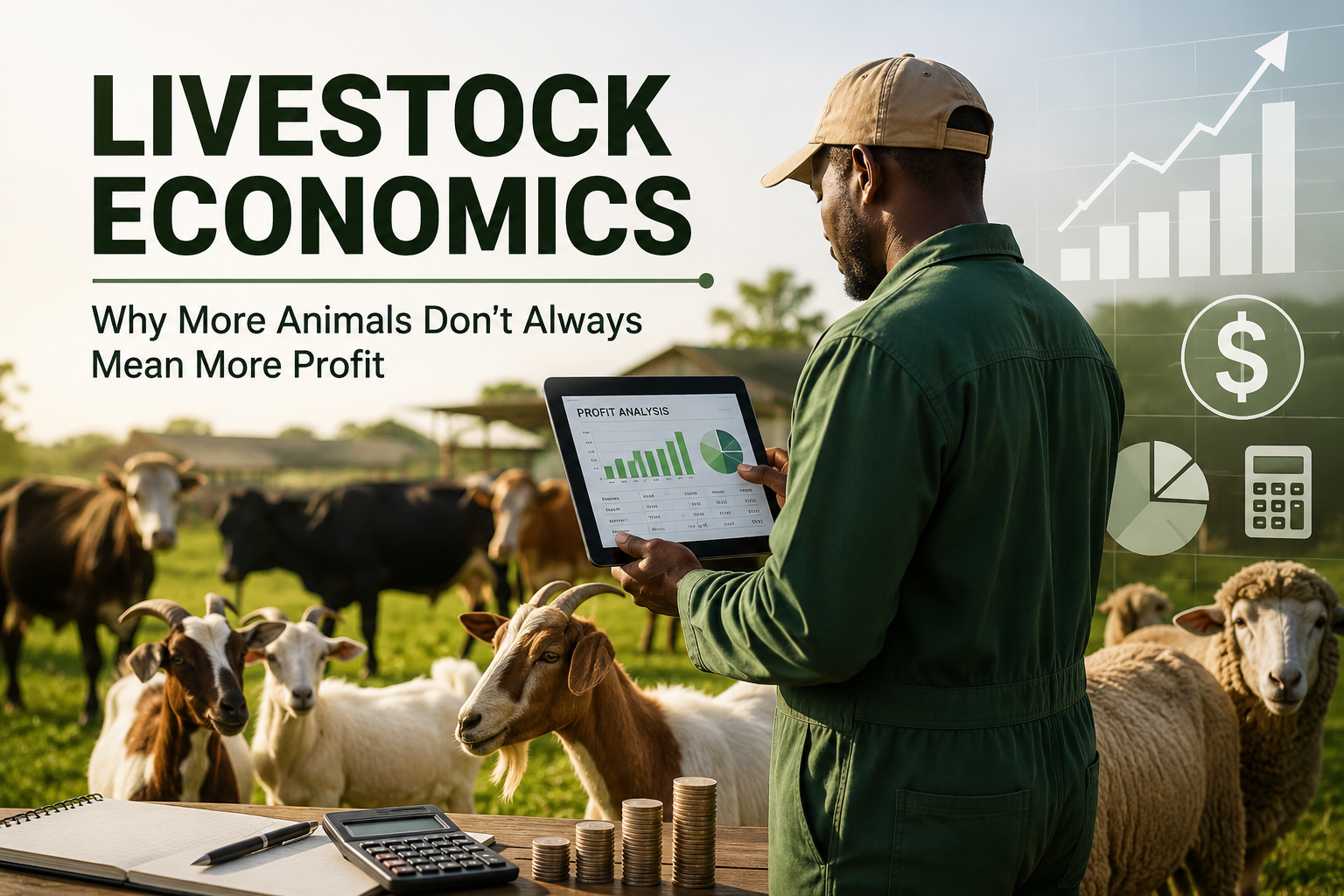
Many farmers measure success by one number: the number of animals they own.
100 goats sounds better than 50 goats.
50 cattle sounds more impressive than 20 cattle.
A ewe producing twins appears more valuable than one producing a single lamb.
But farming is a business, and the largest herd isn’t necessarily the most profitable one.
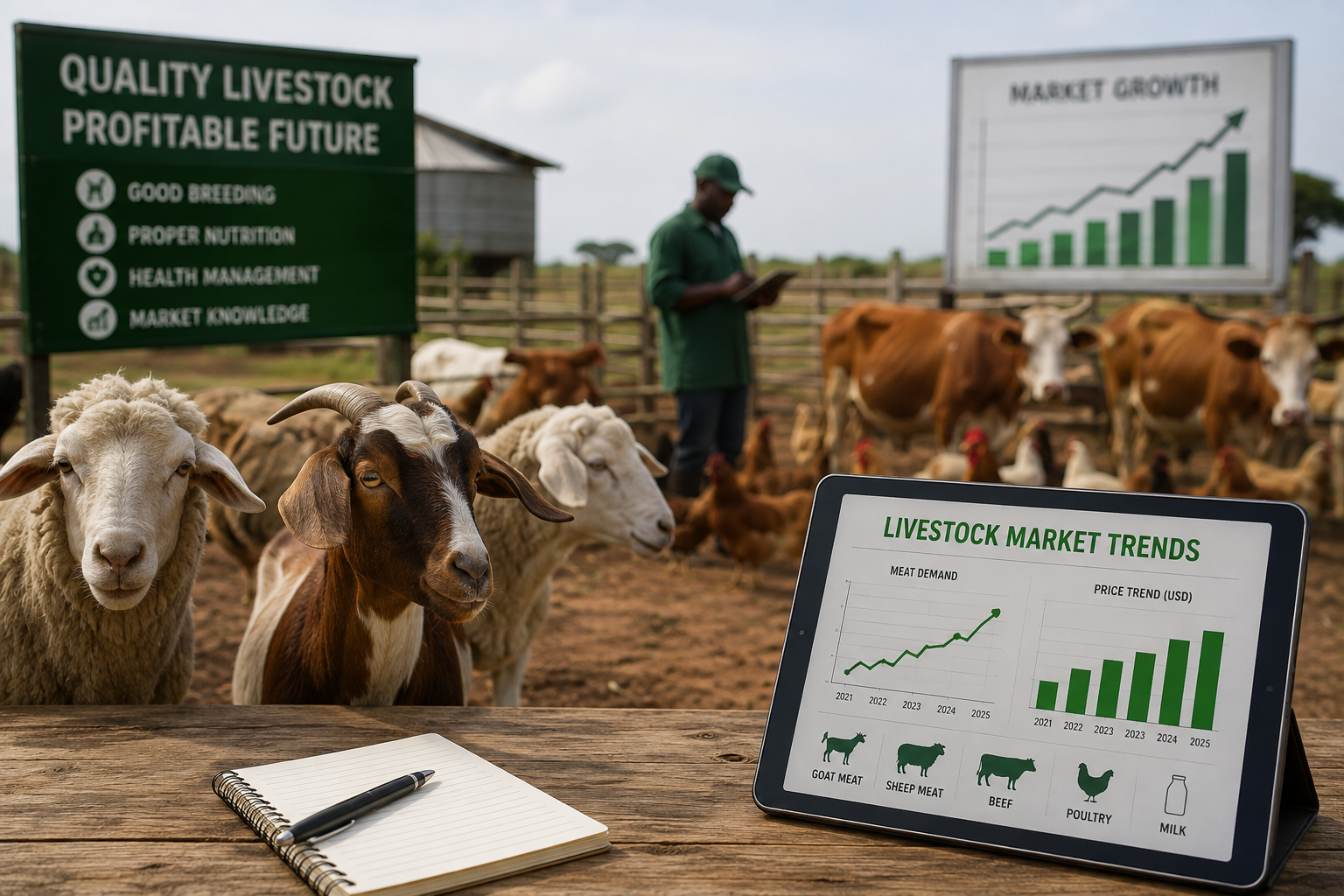
Welcome to Livestock Economics at Ajile Farms—where we look beyond the number of animals on the farm and examine the numbers behind the business.
The Question Farmers Should Be Asking
Instead of asking:
“How many animals do I have?”
Ask:
“How much profit does each animal generate?”
Consider two hypothetical sheep farms.
Farm A
- 100 breeding ewes
- $25,000 annual livestock revenue
- $19,000 total annual costs
- $6,000 operating profit
Farm B
- 70 breeding ewes
- $23,000 annual livestock revenue
- $14,000 total annual costs
- $9,000 operating profit
Farm A owns 30 more breeding animals and generates more revenue.
But Farm B produces 50% more operating profit in this simplified example.
Why?
Because revenue is only half of the equation.
Every Animal Has an Economic Cost
Every additional animal requires resources.
Depending on the production system, those costs may include:
- Feed and forage
- Land or pasture
- Veterinary care
- Medication and vaccination
- Labor
- Housing and fencing
- Water
- Transportation
- Breeding costs
- Equipment
- Financing
- Death and disease losses
Adding another 20 animals may increase revenue, but it also increases expenses.
The important question is whether the additional revenue exceeds the additional cost.
That’s where livestock economics becomes useful.
Production Is Not the Same as Profit
Imagine two ewes.
Ewe A produces twins consistently but requires supplemental feed, frequent treatment and additional attention.
Ewe B normally produces one strong lamb but survives largely on pasture, rarely needs treatment and weans a healthy lamb consistently.
Which ewe is better?
From a production standpoint, Ewe A may appear to win.
From a profitability standpoint, we don’t have enough information yet.
We need to know:
Revenue from offspring − total cost of keeping the ewe = contribution to farm profit
That calculation can completely change the answer.
The same principle applies to cattle, goats, poultry and virtually every commercial livestock operation.
Bigger Isn’t Automatically Better
Economies of scale are real.
A larger operation can spread equipment, labor, transportation and other fixed costs across more animals.
But scale has limits.
If a farmer expands from 100 sheep to 300 without enough pasture, feed costs may rise sharply.
More workers may be required.
Disease management may become more difficult.
Mortality may increase.
Borrowing costs may appear.
At some point, the next animal added to the farm may contribute less profit than the previous one.
Growth makes sense when the economics support the growth.
Market Prices Can Change Everything
Farmers don’t control every variable.
Suppose a goat sells for $250 today.
Six months later, similar goats are selling for $350.
The farmer didn’t necessarily create the entire additional $100 through production.
Part of that increase could come from:
- Seasonal demand
- Reduced market supply
- Inflation
- Higher consumer demand
- Feed shortages
- Transportation costs
- Regional livestock shortages
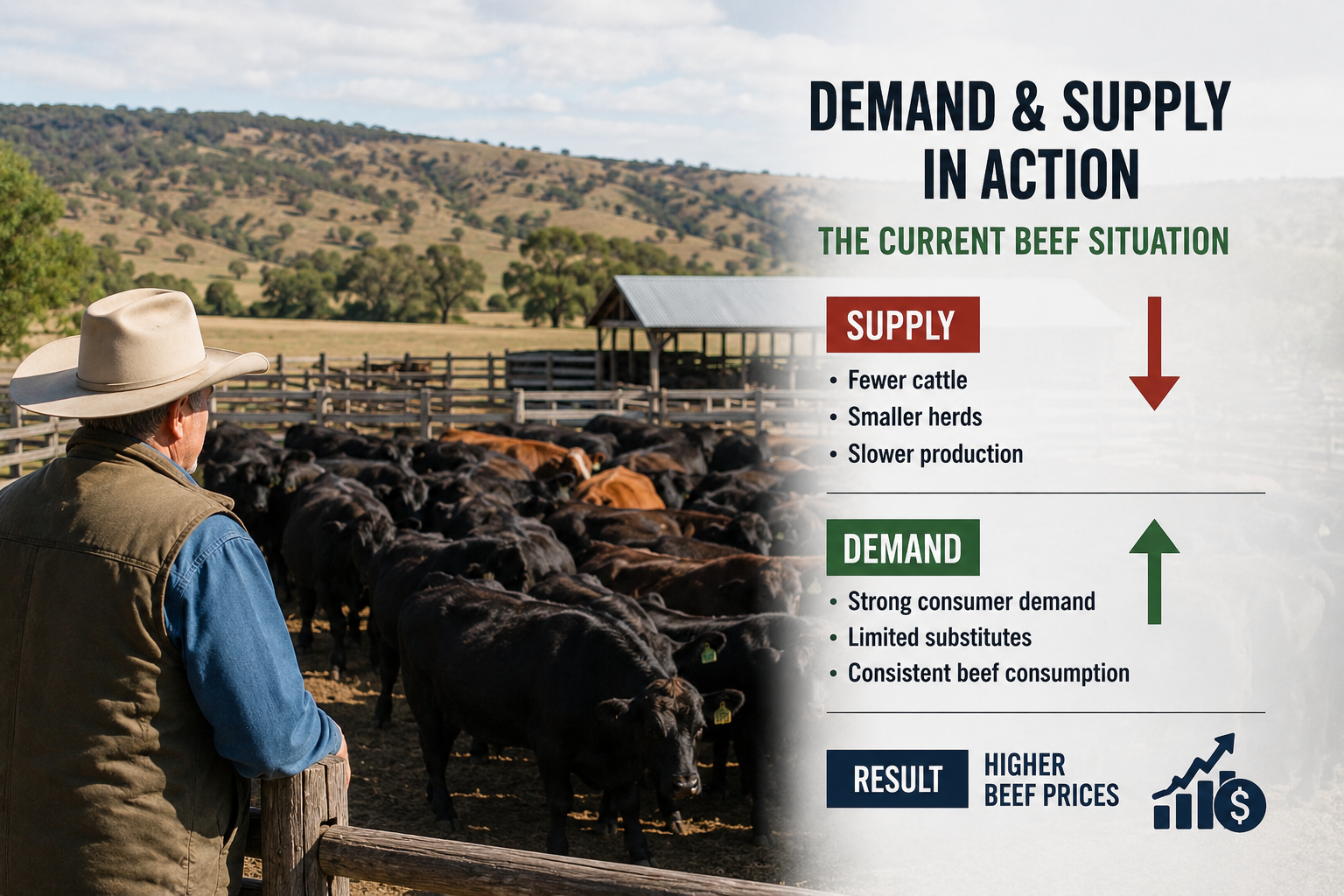
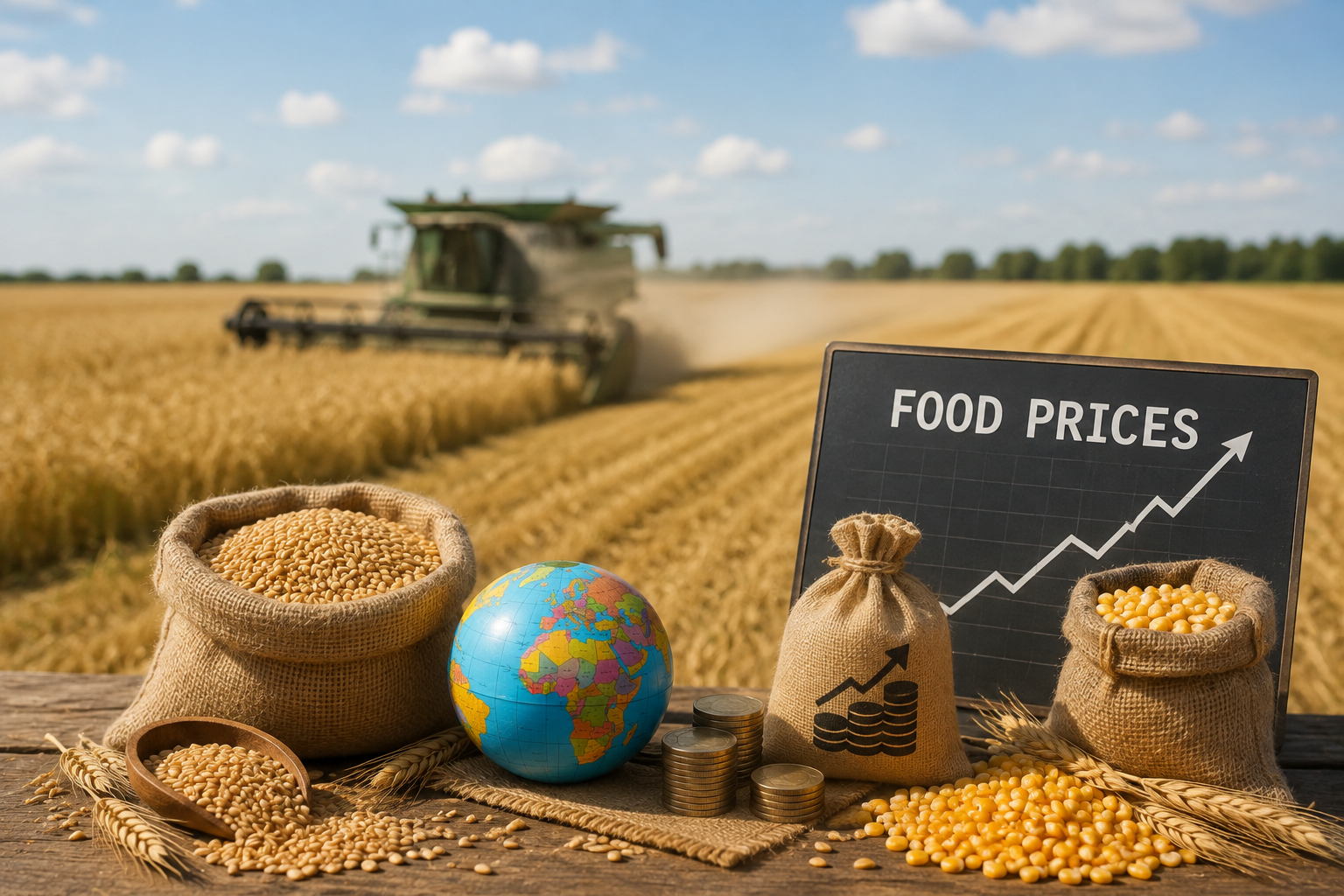
This is why understanding markets matters almost as much as understanding production.
A farmer can be excellent at raising animals and still make poor business decisions if animals are consistently bought, produced or sold at the wrong price.
The Middle of the Supply Chain Matters Too
The economics don’t stop when an animal leaves the farm.
Between producer and consumer there may be livestock traders, transporters, processors, wholesalers, distributors and retailers.
Each participant adds costs, takes risks and seeks a margin.
That means a large increase between the farm-gate price and the final retail price doesn’t automatically become additional income for the farmer.
Understanding who captures value across the supply chain is an important part of understanding agricultural profitability.
Five Numbers Every Livestock Farmer Should Know
You don’t need to be an economist or accountant.
Start by knowing:
1. Cost per breeding animal
How much does it actually cost to maintain each productive female annually?
2. Cost per offspring produced
Include the mother’s costs—not just what you spend directly on the offspring.
3. Mortality rate
An animal that dies represents lost capital, feed, labor and potential revenue.
4. Average selling price
Don’t judge performance using your highest sale. Track the average.
5. Profit per productive animal
Ultimately, this is more useful than simply counting animals.
A farmer who knows these five numbers can make much better decisions about breeding, feeding, expansion and selling.
From Farming to Farm Business
This is the philosophy behind the Livestock Economics section of Ajile Farms.
We’ll examine questions such as:
- 20 sheep or 5 cattle—which makes better economic sense?
- Should you expand your herd or improve the productivity of the animals you already own?
- When does buying feed make economic sense?
- Should female offspring be sold or retained for expansion?
- How much does mortality really cost a livestock business?
- When should a farmer sell?
- Does crossbreeding increase profit or simply increase costs?
- How much value do farmers capture compared with middlemen?
- When do economies of scale become diseconomies of scale?
Sometimes cattle will win.
Sometimes sheep will win.
Sometimes goats will win.
And sometimes the smartest decision will be not to expand at all.
The answer depends on the numbers.
The Bottom Line
A farm with 500 animals isn’t necessarily a better business than a farm with 100.
Herd size measures animals. Profitability measures the business.
Successful livestock farming requires good animals, good husbandry and good production—but it also requires understanding costs, prices, productivity, risk and return.
That’s what we’re going to explore with Livestock Economics at Ajile Farms.
Because farming is a business.
Let’s run the numbers.

Leave a Reply